

About Journal Metrics
As journal metrics become more important for scientists and their institutions, a short explanation is listed below.It is important NOT to compare the different journal metrics as the results apply from different calculations.
Science Analysis
The SCImago Journal & Country Rank is a portal that includes the journals and country scientific indicators developed from the information contained in the Scopus database (Elsevier B.V.). These indicators can be used to assess and analyze scientific domains.
This platform takes its name from the SCImago Journal Rank (SJR) indicator, developed by SCImago from the widely known algorithm Google PageRank. This indicator shows the visibility of the journals contained in the Scopus database from 1996.
The image on the right reflects the current state.
For more details, click on it.
SCImago Journal Rank (SJR) Source: 
Developed by Professors Félix de Moya, Research Professor at Consejo Superior de Investigaciones Cientificas and Vicente Guerrero Bote at University of Extremadura, SCImago Journal Rank (SJR) is a prestige metric based on the idea that 'all citations are not created equal'. With SJR, the subject field, quality and reputation of the journal have a direct effect on the value of a citation.
SJR is a measure of scientific influence of scholarly journals that accounts for both the number of citations received by a journal and the importance or prestige of the journals where such citations come from. It is a variant of the eigenvector centrality measure used in network theory. Such measures establish the importance of a node in a network based on the principle that connections to high-scoring nodes contribute more to the score of the node. The SJR indicator, which is inspired by the PageRank algorithm, was developed for extremely large and heterogeneous journal citation networks. It is a size-independent indicator and it ranks journals by their 'average prestige per article' and can be used for journal comparisons in science evaluation processes.
Look at Scimago Journal & Country Rank
Thomson Reuters Impact Factor Source: Thomson Reuters
The annual Journal Citation Report (JCR) Impact Factor is a ratio between citations and recent citable items published. Thus, the impact factor of a journal is calculated by dividing the number of current year citations to the source items published in that journal during the previous two years.
The 5-year impact factor is calculated by expanding the counted articles to the previous five years.
Look at InCites™
SCOPUS CiteScore
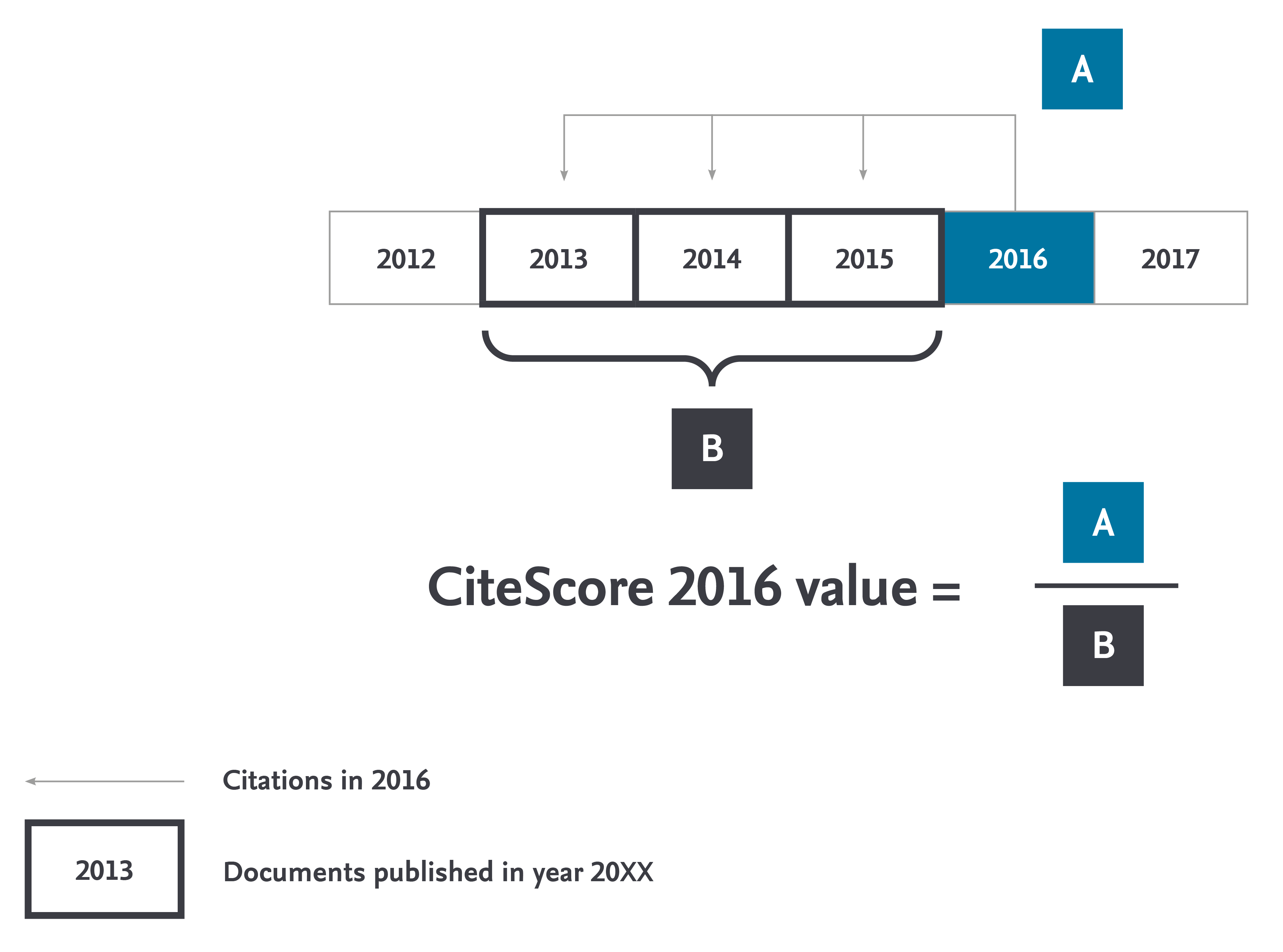
CiteScore is a simple way of measuring the citation impact of serial titles such as journals. Serial titles are defined as titles which publish on a regular basis (i.e. one or more volumes per year).
CiteScore calculates the average number of citations received in a calendar year by all items published in that journal in the preceding three years. The calendar year to which a serial title's issues are assigned is determined by their cover dates, and not the dates that the serial issues were made available online. The method of calculation for CiteScore 2016 is illustrated on the right.
SCOPUS CiteScore Tracker
CiteScore Tracker is calculated in the same way as CiteScore, but for the current year rather than previous, complete years. The CiteScore Tracker calculation is updated every month, as a current indication of a title's performance.
The numerator (citation count) of the current year's metric builds up every month as additional citations are received, so that the construction is consistent with the construction of the complete year CiteScore. CiteScore Tracker is not based on a rolling 12 month window.
The metric values will be fixed in the spring, and then the Tracker will be calculated for the subsequent year. For example, CiteScore 2017 will be complete and fixed in the spring, when CiteScore Tracker 2018 will start to be displayed in Scopus.com.

More Indexes Source Harzing, A.W. (2007) Publish or Perish,
available from http://www.harzing.com/pop.htm
NOTE: Specified below indices depend on how authors are quoting the name of the magazine
(see cover page of this site)
The h-index was proposed by J.E. Hirsch in his paper "An index to quantify an individual's scientific research output", arXiv:physics/0508025 v5 29 Sep 2005.
The g-index was proposed by Leo Egghe in his paper "Theory and practice of the g-index", Scientometrics, Vol. 69, No 1 (2006), pp.131-152.
g-index aims to improve on the h-index by giving more weight to highly-cited articles.
The Contemporary h-index was proposed in Antonis Sidiropoulos, Dimitrios Katsaros, and Yannis Manolopoulos "Generalized h-index for disclosing latent facts in citation networks", arXiv:cs.DL/0607066 v1 13 Jul 2006
This means that for an article published during the current year, its citations account four times. For an article published 4 years ago, its citations account only one time. For an article published 6 years ago, its citations account 4/6 times, and so on.